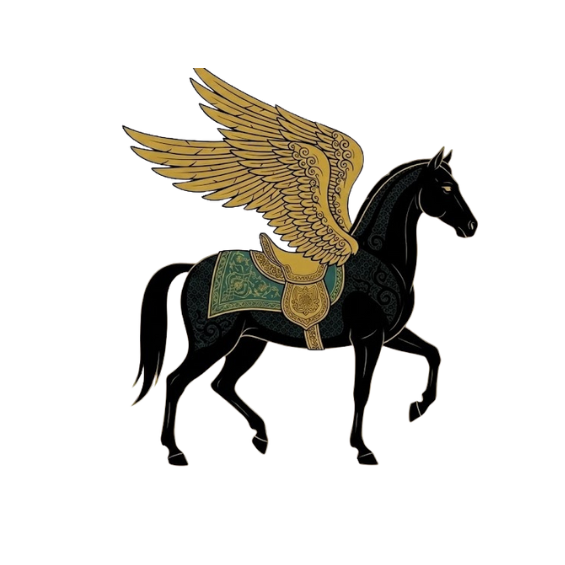
The Graveyard of Empires
To understand why you need this horse, and why you need this map, you must first look at the graveyard that surrounds us.
If we freeze time at 600 BCE, the world is populated by titans. In the Nile Valley, the Egyptians are the masters of stone and eternity. In Mesopotamia, the Babylonians and Assyrians are the masters of law and war. They built civilizations of immense power. They possessed armies, codes of law, and gods that seemed unbreakable. They built Stone Fortresses.
Today, they are dust. Their languages are dead puzzles for linguists. Their gods are museum exhibits. Their distinct ways of being human—their specific "coherence"—dissolved into the background noise of time. When the hammer of history struck them hard enough, they shattered.
But Iran remains.
It has been conquered by Greeks, Arabs, Mongols, and Turks. It has seen its libraries burned, its cities leveled, and its religions overturned. It has been forcibly converted, linguistically besieged, and politically partitioned.
And yet, the "Persian Mind" refused to die. A Persian today can read a poem written a thousand years ago and feel it resonating in their chest as if it were written yesterday. They celebrate Nowruz exactly as their ancestors did in Persepolis.
This survival is a historical anomaly. It violates the law of entropy.
History as Thermodynamics
To explain this anomaly, we need to borrow a lens from physics. We need to understand the war between Entropy and Coherence.
In the physical universe, the Second Law of Thermodynamics rules supreme. It states that in any closed system, Entropy ($S$)—disorder, randomness, the loss of information—will always increase over time. Walls crumble. Iron rusts. Memories fade. Empires fall. Entropy is the current of the river that wants to wash everything away.
But there is a counter-force. It is not a violation of the law, but a loophole within it. It is Coherence ($C$).
Coherence is the alignment of parts into a unified, resonant whole. It is the force that allows a biological organism to maintain its structure against the chaos of the environment. It is the force that allows a laser to cut through steel.
The core thesis of this book is that Persian civilization survived because it functioned as a Coherence Machine.
It did not just build cities (which are fragile); it built a specific, multi-layered cognitive architecture—a "Stack" of reality—that allowed it to process the entropy of invasion and transmute it into new forms of cultural order.
The Ladder of Consciousness
We will map this architecture using the Ladder of Consciousness (The $\mu$-Stack). A resilient civilization must be strong on all seven floors.
- THE ROOTS ($\mu1$): Matter, Territory, State. The Hardware.
- THE RHYTHM ($\mu2$): Ritual, Body, Calendar. The Connective Tissue.
- THE FIRE ($\mu3$): Emotion, Ethics, Temperament. The Energy Source.
- THE MAP ($\mu4$): Reason, Logic, Law. The Blueprint.
- THE GARDEN ($\mu5$): Symbol, Image, Archetype. The Interface.
- THE STORY ($\mu6$): Myth, Narrative, History. The Operating System.
- THE SKY ($\mu7$): Unity, Metaphysics, Absolute Truth. The Orientation.
The Liquid Fortress
Most civilizations build rigid structures. They rely on the strength of the State, the Army, and the Dogma. This is the strategy of the Outer (The Sword). It works, until it breaks.
Persia built a Liquid Fortress.
It constructed a civilization that integrated the rigidity of the Crystal with the adaptability of the Water.
- The Outer: The Kings and Philosophers built the State and the Logic. They provided structure.
- The Inner: The Mothers and Mystics built the Home and the Myth. They provided resilience.
When the State collapsed, the Culture became liquid. It retreated from the palaces into the kitchens, from the law courts into the poetry circles. It changed its shape to fit the vessel of the conqueror, but it never lost its substance. And eventually, like water, it eroded the stone of the conqueror and reclaimed the land.
This book is the story of how those layers were built. It is a manual for building a mind that functions like Shabrang: strong enough to hold the weight of the past, but fluid enough to navigate the currents of the future.
The horse is beneath you. The current is strong.
Let us see how the water flows.