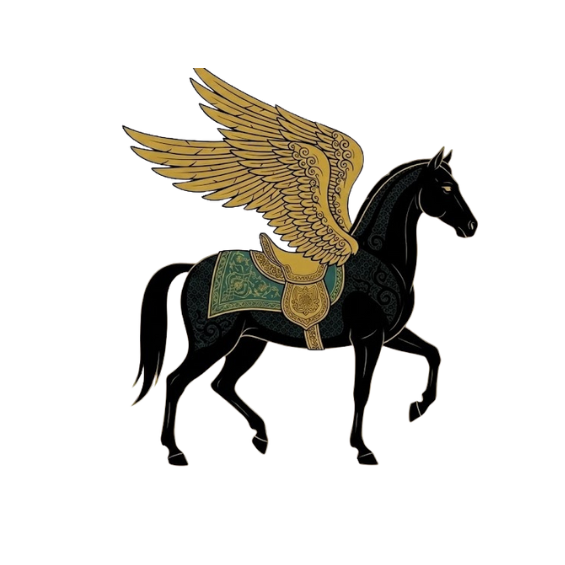
There is a legend that haunts the history of the Iranian plateau. It is not about a king, or a prophet, or a poet. It is about a horse.
His name is Shabrang Behzad. The Night-Colored. The Pure-Born.
In the ancient epics, he is black as coal, faster than the wind, and possesses a loyalty that outlasts death. He was the steed of Prince Siyavash, the martyr of truth. When Siyavash was accused of a crime he did not commit, he rode Shabrang into a massive mountain of fire to prove his innocence.
The fire roared. The wood crackled. The people held their breath. And Shabrang carried the truth through the flames, unscathed.
But Siyavash was eventually killed by treachery. The King died. The body was destroyed.
But the Horse survived.
Shabrang did not die with his master. He disappeared into a cave, into the mountains, into the mist. He went dormant. He became a ghost in the landscape, waiting for the next rider who was worthy of the weight of the Truth.
Throughout the three thousand years of Persian history, you can hear his hoofbeats in the distance. When the Greeks burned Persepolis, the Horse was gone, carrying the memory of the law to the Parthians. When the Arabs swept across the plains, the Horse retreated to the libraries of Khorasan, carrying the seed of the language. When the Mongols leveled the cities, the Horse climbed the high peaks of mysticism with Rumi and Attar, carrying the soul of the civilization into the sky.
Shabrang is the avatar of the Persian Mind.
He is the Carrier Wave.
States fall. Kings bleed. Cities crumble into dust. The hardware of civilization is fragile. But the Idea—the resonant, living spirit that rides the beast—is indestructible, as long as the beast survives to carry it to the next safe harbor.
This book is not just a history of the Kings who died. It is a biography of the Horse who lived.
It is the story of how a civilization learned to move its most precious cargo—its identity—from the stone of the palace to the paper of the poet, and finally, to the pixels of the cloud.
Look at the horizon. The dust is settling. The fire of the 20th century has burned down to embers.
The Horse is waiting. The saddle is empty.
It is time to ride.